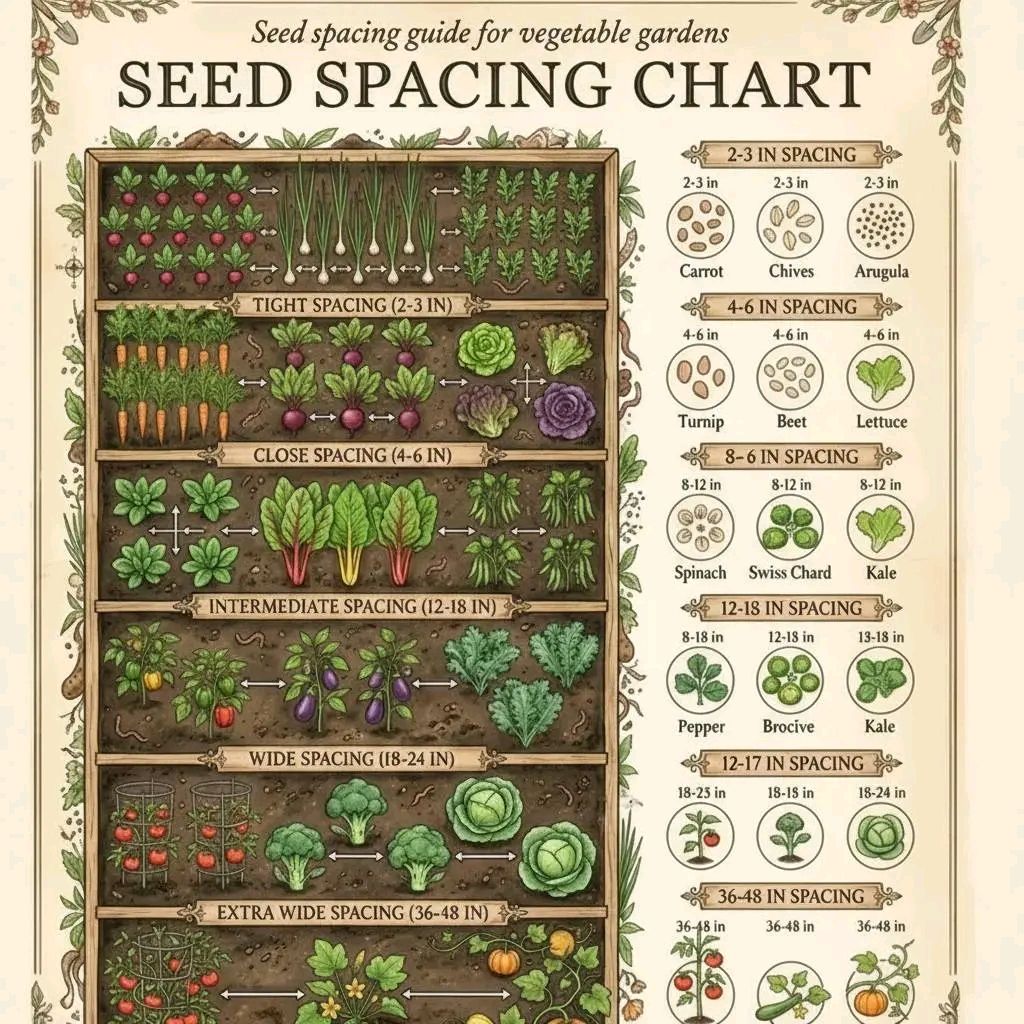


Seed Spacing Guide: The Secret to a Productive Garden
Spacing matters just as much as planting depth — and it’s the detail most gardeners overlook. Too close? Plants compete and underperform. Too far? You waste valuable growing space.

The measurements below are final spacing after thinning.
If direct sowing, plant 2–3 seeds per spot and thin to the strongest seedling.
—

2–3 Inches Apart
Radish — crowding causes misshapen roots. Thin early.
Green onion — grows upright, minimal spread.
Arugula — tight clusters work well for cut-and-come-again harvests.
4–6 Inches Apart
Carrot — needs loose soil space; crowding causes twisting.
Beet — thin seed clusters to one plant for full-sized roots.
Leaf lettuce — 4 inches for baby leaves, 6–8 for full heads.
8–12 Inches Apart
Spinach — better airflow = bigger leaves, less mildew.
Swiss chard — wide rosette shades weeds naturally.
Bush bean — 8 inches gives light while allowing light mutual support.
12–18 Inches Apart
Pepper — needs airflow; crowding reduces fruit set.
Eggplant — wide branches carry heavy fruit.
Kale — spreads wide by midsummer — space pays off later.
18–24 Inches Apart
Tomato (determinate) — bush types need airflow to prevent disease.
Broccoli — space ensures large central heads.
Cabbage — outer leaves must spread to form tight heads.
36–48 Inches Apart
Tomato (indeterminate) — 3 ft (caged), 4 ft (staked).
Zucchini — massive leaves spread 3–4 ft wide.
Winter squash — vines run 6–10 ft; trellis if space is limited.
—

Final Thought:
A thriving garden often comes down to just a few extra inches. What feels like “too much space” in spring becomes the reason for a full, healthy harvest by summer.